Big win for tax-evading cigarette industry?

Officer behind multi-billion rupee crackdown now under controversial investigation
Tos:
Islamabad: A Federal Investigation Agency (FIA) inquiry into the alleged theft of seized cigarette stocks in Khyber Pakhtunkhwa has sparked controversy, with Federal Board of Revenue (FBR) sources claiming the investigation has shifted its focus from identifying those responsible for the theft to scrutinising field officers who previously led major anti-tax evasion operations against the tobacco industry.
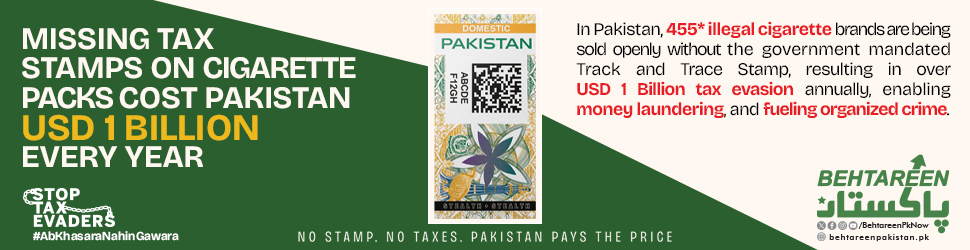
According to official records reviewed by this correspondent, the case began in 2024 when the Regional Tax Office (RTO) Peshawar, under the supervision of Deputy Commissioner Inland Revenue Faheem Rasheed, seized 1,262 cartons of non-duty-paid “Kisan” brand cigarettes allegedly lacking the mandatory Track and Trace System and carrying counterfeit tax stamps. The seized stock was linked to Paramount Tobacco Company, while the “Kisan” brand is registered to Khyber Tobacco Company, whose owners are reported to be close relatives.
Due to the absence of official storage facilities, the confiscated cigarettes were moved to a warehouse in Shahbaz Garhi, Mardan, where products seized from Souvenir Tobacco Company were also stored. In a separate operation, authorities secured another warehouse in Yar Hussain, Swabi, containing around 86,000 kilograms of raw tobacco linked to Paramount Tobacco Company.
Official documents show that Faheem Rasheed repeatedly wrote to senior FBR officials between April and June 2024, requesting improved warehouse and security arrangements.
Despite these requests, a major security breach later occurred at the Mardan warehouse, where nearly 80 percent of the seized cigarette stock was allegedly stolen. According to records, the same enforcement team subsequently recovered the missing stock and shifted it to the Swabi warehouse for better security.
Following the transfer of several officers, including Faheem Rasheed, another theft was reported at the Swabi warehouse, where approximately 2,800 cartons allegedly disappeared. An FIR was registered by then Deputy Commissioner Inland Revenue Muhammad Waqas. However, FBR sources questioned the impartiality of the local police investigation, alleging conflicts of interest involving individuals linked to the tobacco industry. The matter was later transferred to the FIA after intervention from higher authorities.
According to FBR sources, concerns intensified after the inquiry increasingly focused on Faheem Rasheed, who had led several high-profile enforcement actions against influential tobacco companies.
Official records show that in August 2024, Faheem Rasheed led an operation against Universal Tobacco Company, allegedly owned by the family of Senator Faisal Saleem Rehman, seizing cigarette filter rods and about 76,660 kilograms of acetate tow, with alleged duty evasion exceeding Rs3.3 billion. He also played a leading role in exposing an acetate tow smuggling network, resulting in seizures worth around Rs4 billion and the recovery of approximately Rs1 billion in cash.
FBR sources said enforcement operations also targeted factories linked to another senator and recovered more than Rs600 million from entities described in official records as front companies. During 2025, FBR teams conducted further raids against several tobacco companies, including Indus Tobacco, Souvenir Tobacco, Universal Tobacco and Khyber Tobacco, seizing non-duty-paid cigarettes, undeclared machinery and millions of kilograms of tobacco and raw materials with significant revenue implications.
FBR officials allege that the ongoing FIA inquiry and proceedings before a Senate committee risk discouraging enforcement officers from pursuing influential tax evaders and smugglers. They argue that the investigation should focus on determining how repeatedly seized goods disappeared from official custody rather than targeting officers who carried out enforcement operations.
According to FBR sources, the outcome of the case is being closely watched across Pakistan’s tax enforcement community as a test of whether officers pursuing large-scale tax evasion cases will receive institutional support or face pressure for taking action against politically influential interests.