Suthra Punjab gears up for Eid cleanliness drive
Tos:
Lahore:The Punjab government has initiated a province-wide cleanliness campaign for Eid-ul-Adha under its flagship “Suthra Punjab” programme, aimed at ensuring a clean and hygienic environment across the province during the festive occasion.
According to official estimates, nearly 3.5 to 3.7 million animals are expected to be sacrificed across Punjab during Eid al-Adha this year. Managing the disposal of animal waste and offal on such a massive scale has always been an enormous administrative challenge. Cleanliness, however, holds a central place in Islamic teachings and is regarded as half of faith. Clean cities and hygienic surroundings are admired worldwide, and Punjab is increasingly recognized for setting new standards of cleanliness and sanitation.
The credit for this transformation largely goes to Chief Minister Maryam Nawaz, who introduced the Suthra Punjab programme, one of the largest cleanliness and waste management systems in the world. The success of the initiative has been acknowledged by media outlets from the West, the East, and the Middle East alike.
More than 100,000 people have received direct employment opportunities under the Suthra Punjab project. One of the most notable features of the programme is that all machinery, including vehicles, loader rickshaws, workers’ uniforms, and operational equipment, has been manufactured locally under the “Made in Pakistan” vision. No imported material has been used, resulting in billions of rupees in economic benefits for Punjab’s local industry.
The issue of disposing of sacrificial waste during Eid al-Adha has historically remained a major civic challenge. Last year, for the first time, Punjab introduced a grand Eid cleanliness operation under the Suthra Punjab programme. Citizens witnessed a visible transformation as roads, streets, and residential neighborhoods remained free of animal waste throughout the three days of Eid. Roads were even washed with rose water, reflecting the scale and seriousness of the campaign.
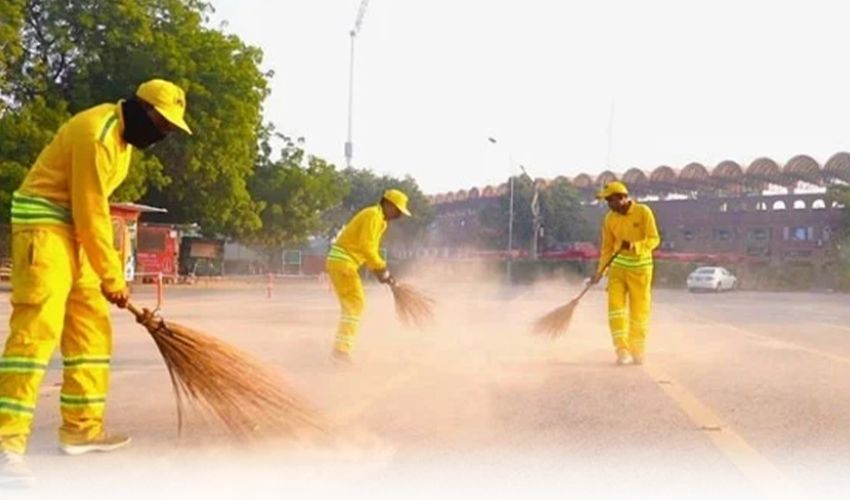
This year, the operation has been expanded further. Around 184,000 Suthra Punjab workers are participating in the campaign, supported by approximately 60,000 vehicles. The Punjab government has distributed more than 12 million environmentally friendly waste bags for the collection of sacrificial waste, while over 3,800 primary collection centres have been established across the province.
More than 12,000 loader rickshaws and pickup vehicles have been deployed specifically for waste collection and transportation. Operational camps have been set up in over 4,000 union councils, while special waste management arrangements have also been made for 288 cattle markets and sale points across Punjab.
In addition, 40,000 litres of rose water will be used for washing roads and public spaces during Eid. Dedicated sanitation teams have been assigned to 2,687 commercial markets throughout the province. Overall, 4,500 operational camps and more than 1,200 designated slaughter points have been established for the Eid cleanliness operation.
Punjab Information Minister Azma Bukhari and Provincial Minister for Local Government Zeeshan Rafiq have taken the lead in the public awareness campaign and operational oversight of the initiative.
During a recent press conference, Azma Bukhari highlighted that, unlike previous years, no unpleasant incidents involving traders or citizens were reported in cattle markets this year. She also stated that the Suthra Punjab helpline would remain operational round the clock with a commitment to ensuring a 100 percent response rate.
Zeeshan Rafiq termed sanitation workers the true heroes of the campaign and urged citizens to treat them with dignity and respect. He emphasized that maintaining a clean Punjab is a shared responsibility and that citizens must also play their role in supporting the cleanliness drive.
Azma Bukhari further pointed out that strict action would be taken against those disposing of sacrificial waste irresponsibly. Throwing animal waste in empty plots, drains, canals, or public places has been completely prohibited, and violators may face fines of up to Rs50,000.
The Punjab government’s decision to enforce these regulations ahead of Eid has been widely appreciated. Even on ordinary days, the visible reduction of garbage on roads and in neighborhoods reflects an increasing sense of civic responsibility among the public. Sacrifice is a religious obligation and a sacred act, but leaving animal waste unattended outside homes and in streets can no longer be tolerated. Citizens have been urged to place waste in the officially distributed bags and hand them over to Suthra Punjab teams for timely disposal.
Chief Minister Maryam Nawaz has repeatedly made it clear that there will be no compromise on cleanliness standards. During a recent video-link meeting with district administrations, she directed officials to remain present in the field during Eid rather than staying inside air-conditioned offices. Her governance style is widely seen as result-oriented, with a strong emphasis on accountability and efficient implementation.
She recently reiterated to the Suthra Punjab administration that since all necessary resources had been provided by the government, the results must also be delivered at 100 percent efficiency. During all three days of Eid, Provincial Minister Zeeshan Rafiq, Secretary Local Government Mian Shakeel, Chairman Suthra Punjab Authority Babar Sahib, and district-level officials will remain present in the field alongside sanitation workers to supervise the operation.
Suthra Punjab initiative has undeniably provided Punjab with a new identity. Other provinces are also seeking details of the programme and learning from Punjab’s experience. The governments of Khyber Pakhtunkhwa and Sindh have already sought guidance from Punjab on various governance and public service initiatives.
Maryam Nawaz has openly stated on several occasions that Punjab is fully willing to share the details of any successful public welfare project with other provinces. The governance model based on development, public service, and administrative efficiency introduced under her leadership is expected to prove highly beneficial for Punjab in the years ahead.
Establishing a system is difficult, but sustaining and effectively running it is an even greater challenge. The chain of command and administrative discipline introduced in Punjab’s institutions under Maryam Nawaz’s leadership have significantly improved institutional performance. The results are now becoming increasingly visible to the public, which is also contributing to her rapidly growing popularity across Punjab.